
Brandon W. Mosley · Design Leader

Role Product Designer · UX Writer
Partners Client · Digital Strategist · Product · Front-end Engineering
Deliverables User Profiles · User Stories · Sitemap · Wireframes · Design System · High-fidelity
Tools Flowmapp · Axure · Sketch · Illustrator
Timeframe 2 years
Company GeekHive
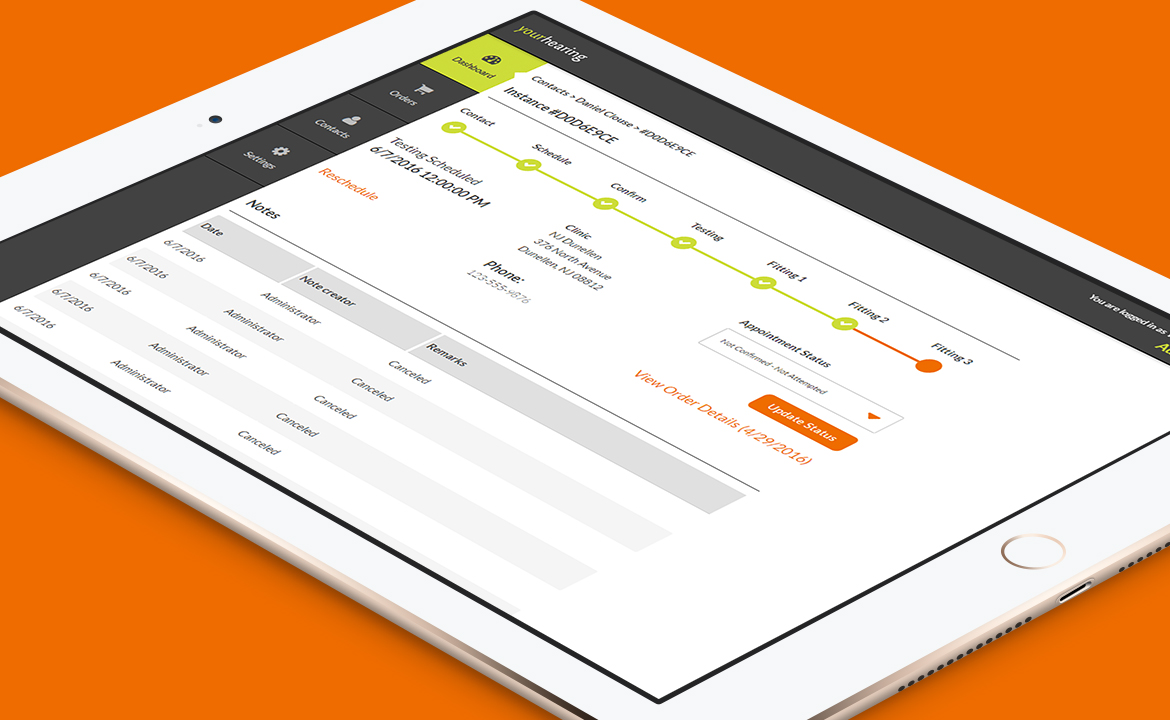
An initial portal was developed primarily for contact management and appointment scheduling. However, this missed the mark: most audiologists already had established tools for these tasks and did not perceive them as pain points. As a result, the portal failed to address a real user need, resulting in low engagement.
Independent hearing healthcare providers manage busy practices with manual, paper systems and small teams. Without a digital system to credential doctors, handle claims, and enroll in other office management services, hearing health practices can't scale. For small practices, the gap is bigger. Without extra help, such as a call center, they struggle to provide steady patient service and keep their practice running.
As YHN rebranded and expanded its service offerings, it took on responsibility for helping its parent company, Oticon, sell its products. Thus, YHN sought to rebuild the provider portal to address challenges in real-world workflows and create value to drive service enrollment and grow the network.

Users didn't find value fast enough to stay
Without clear onboarding or self-guided support, users struggled to understand the platform's value, stalling adoption.
Daily operations required manual processes
Credentialing, filing claims, and services enrollment were paper-based and time-consuming, leaving lean practice staff with no digital tools to manage critical workflows efficiently.
The portal wasn't built for the right people
The first portal failed to convert because it was designed around the wrong user priorities — missing the goals and workflows of practice owners, providers, and office managers who needed it most.

Increase portal usage
Accelerate user adoption and increase active portal users by identifying personas and providing platform value.
B2C empowerment
Empower audiologists by digitizing manual and paper-based processes and deliver tools that enable self-management and efficient operations.
Increase product sales
Broaden market reach and revenue by increasing enrollment in digital products and services.
Discovery began by finding out why the first portal did not convert. I led interviews and workshops with client stakeholders to clarify business priorities and rethink the target user strategy from the start.
Practice owners, providers, and office managers surfaced as the core personas. I synthesized behavioral insights, motivators, pain points, and goals into actionable user personas, then facilitated user story mapping sessions to define and prioritize scope.

I led client workshops using card sorting exercises to architect user flows and navigational structures, and to practice tool concepts. Iterative stakeholder collaboration moved ideas from the whiteboard to prototype-ready.

Finalized sitemaps and user flows established the full navigational architecture and critical task paths. These artifacts functioned as the strategic blueprint that aligned cross-functional stakeholders around a unified direction before design execution began.
I designed wireframes to translate strategic intent into concrete design decisions and page flows. Wireframes defined information architecture, surfaced critical interaction patterns, and illustrated key user task sequences.


I established a Bootstrap-based design system to incorporate YHN’s brand identity and alleviate engineering lift. Adopting Bootstrap gave the team scalable, reliable components and a shared design-to-development vocabulary. This reduced handoff friction and sped up production.
Responsive components supported advanced interactions. Dense data became graphs and charts, making information scannable and actionable. Tutorials eased new user onboarding. A mobile-first approach ensured a polished experience on every device.


A failed portal evolved into a scalable, brand-aligned product. It transformed how independent hearing health providers manage their practices. The team anchored decisions in user needs and systems thinking. The result: an intuitive, visually cohesive, and scalable experience.
The Bootstrap-based design system unified brand expression across the platform. Engineering had a clear, efficient production path. Confusing information architecture was restructured for natural navigation. Complex data was made scannable. Onboarding became self-directed.
78%
Number of users who rated the user interface as highly visually pleasing to look at and use.
89%
Number of users who reported satisfaction with the portal information delivery & architecture.
86%
Number of users reported satisfaction with the portal's navigation and wayfinding.

Continuous research is critical
Incorporating the customer's voice early is critical; without it, teams risk shipping experiences that fail to meet real needs.
Design for mobile
Mobile usage will continue to grow, making it essential to future-proof experiences, even when initial usage skews desktop.
Data & user needs drive UX
UX alone cannot resolve data inconsistencies; prioritize data quality, content strategy, and user needs from the start.


